Products You May Like
The composer and virtuoso pianist launches After the Masters – School of Velocity with a breathtaking new work where classical tradition meets speed, tension and modern imagination
There are moments in music when technical brilliance becomes so polished that it risks becoming predictable. Avohee Avoher seems determined to make sure that never happens to the piano.
His new single “Valenor” doesn’t sound like a musician carefully tiptoeing through classical tradition. It sounds like someone grabbing hold of that tradition, accelerating it and seeing how far it can be pushed before something entirely new begins to emerge.
Released August 31, “Valenor” is the opening work from Avoher’s ambitious new project, After the Masters – School of Velocity, following his earlier 12V cycle. But this isn’t simply the beginning of another collection of compositions. It feels more like the announcement of a new creative period for the pianist.
And the title tells you almost everything you need to know.
After the Masters.
Not Instead of the Masters. Not Imitating the Masters.
After them.

The Piano as an Instrument of Motion
From the opening moments of “Valenor,” Avoher puts movement at the center of the experience.
A minor-key idea establishes an immediate sense of tension. Rapid passages begin moving across the keyboard. Rhythms shift and syncopations destabilize the music just when the listener thinks they understand where it’s headed.
The result can feel cinematic—almost like a chase taking place without pictures.
Then Avoher does something more interesting.
He backs away.
The velocity suddenly gives way to quieter passages where the piano becomes delicate and exposed. What initially sounded almost aggressive reveals another personality entirely.
And then the momentum returns.
That tension between power and vulnerability may be the most compelling thing about “Valenor.” The technical difficulty is obvious, but Avoher doesn’t seem particularly interested in making difficulty the point.
Speed isn’t the destination. It’s part of the vocabulary.
The faster passages create urgency. The rhythmic disruptions generate unease. The quieter moments feel more intimate precisely because of the musical storm surrounding them.
Virtuosity becomes storytelling.

Liszt and Rachmaninoff Are in the Room
The title After the Masters carries considerable weight, particularly when the musical giants informing the project include Franz Liszt and Sergei Rachmaninoff.
Both fundamentally expanded ideas about what the piano—and the pianist—could accomplish.
But “Valenor” isn’t an attempt to write a lost Liszt composition in the 21st century.
Avoher is taking elements of the technical and musical vocabulary inherited from those figures and putting them through his own contemporary sensibility. Even more interestingly, Avoher’s own pianistic lineage traces back to Liszt, making the relationship between past and present more than an abstract artistic concept.
It raises a fascinating question.
What does a musician owe the masters who came before him?
Preservation?
Imitation?
Reverence?
Avoher appears to have chosen something else: evolution.
The greatest tribute to musical history may not be reproducing it perfectly. It may be understanding it deeply enough to take the next risk.
From 12V to “Valenor”
“Valenor” also makes more sense when viewed alongside Avoher’s previous project, 12V.
That collection was built around twelve emotional “voltages,” with Avoher using piano composition to explore different states of human experience. Importantly, listeners weren’t handed a rigid narrative explaining exactly what they were supposed to feel.
That idea survives in “Valenor.”
There is no single storyline attached to the composition.
One listener might hear pursuit.
Another might hear ambition.
Someone else could hear anxiety, liberation, longing or determination.
Avoher provides the musical architecture but leaves room for the audience to inhabit it.
What has changed since 12V is the machinery.
With After the Masters, emotion is increasingly being delivered through velocity, complexity and the sheer physical possibilities of the piano.

Why “School of Velocity” Is Such an Interesting Idea
Calling the project School of Velocity could easily create the wrong impression.
This isn’t simply about playing as many notes as humanly possible.
Velocity can mean the speed at which a musical thought develops. It can describe rhythms moving against one another, themes chasing each other or emotional tension accelerating toward a breaking point.
And Avoher intends to expand that idea.
The larger After the Masters – School of Velocity project is planned as a waterfall series of releases, with its musical world eventually extending beyond solo piano into compositions for two pianos.
That’s where the concept could become especially fascinating.
Two pianos allow musical ideas to collide.
One can pursue while another escapes. They can mirror each other, interrupt each other or create layers of rhythm and counterpoint beyond what a single performer can physically produce.
At that point, velocity becomes dialogue.
Maybe even combat.

A New Chapter Begins at Abbey Road
There is also an intriguing bridge between musical history and modern production behind the recording itself.
“Valenor” received its final sonic dimensions at Abbey Road Studios, with mastering by Stefan Brown—adding another legendary musical institution to a project already deeply engaged with the idea of artistic inheritance.
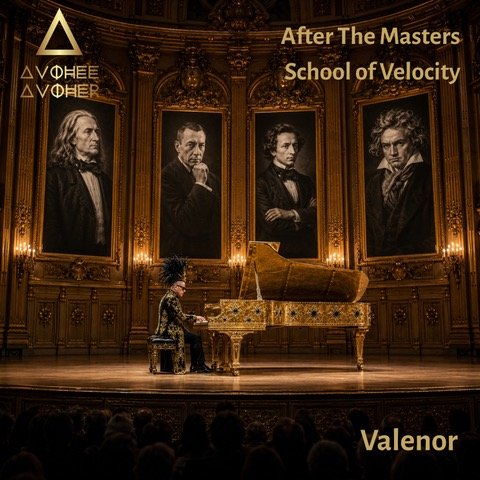
The accompanying artwork captures that idea beautifully.
Avohee Avoher sits at an ornate golden piano inside a magnificent concert hall. Towering portraits of classical masters surround him from above.
But Avoher isn’t staring at them.
He isn’t bowing to them.
He’s playing.
That distinction feels important.
Because “Valenor” isn’t arguing that the past should disappear. Quite the opposite. Avoher appears fascinated by musical history.
He simply refuses to believe that history has finished speaking.

What Comes Next?
That’s ultimately what makes After the Masters – School of Velocity such an intriguing proposition.
The title itself is a question disguised as a statement.
What happens after Liszt?
What happens after Rachmaninoff?
What happens after generations of pianists have explored nearly every conceivable corner of an instrument containing the same 88 keys?
Maybe the answer isn’t another revolution in the instrument.
Maybe it’s a revolution in what someone imagines those keys can still say.
With “Valenor,” Avohee Avoher isn’t trying to escape the masters. He’s taking everything they left behind and running with it.
Fast.
And if Valenor really is only the beginning of the School of Velocity, the most interesting part may be discovering just how far he’s prepared to go.
“Valenor,” composed and performed by Avohee Avoher, is the opening release from After the Masters – School of Velocity and is available now on major streaming platforms.