Products You May Like
Using living neurons as the foundation of computer chips promises to bring significant advantages over conventional systems in terms of both energy efficiency and adaptability: As sophisticated as AI is, the human brain needs a lot less power to run and is still much better at dealing with the unfamiliar.
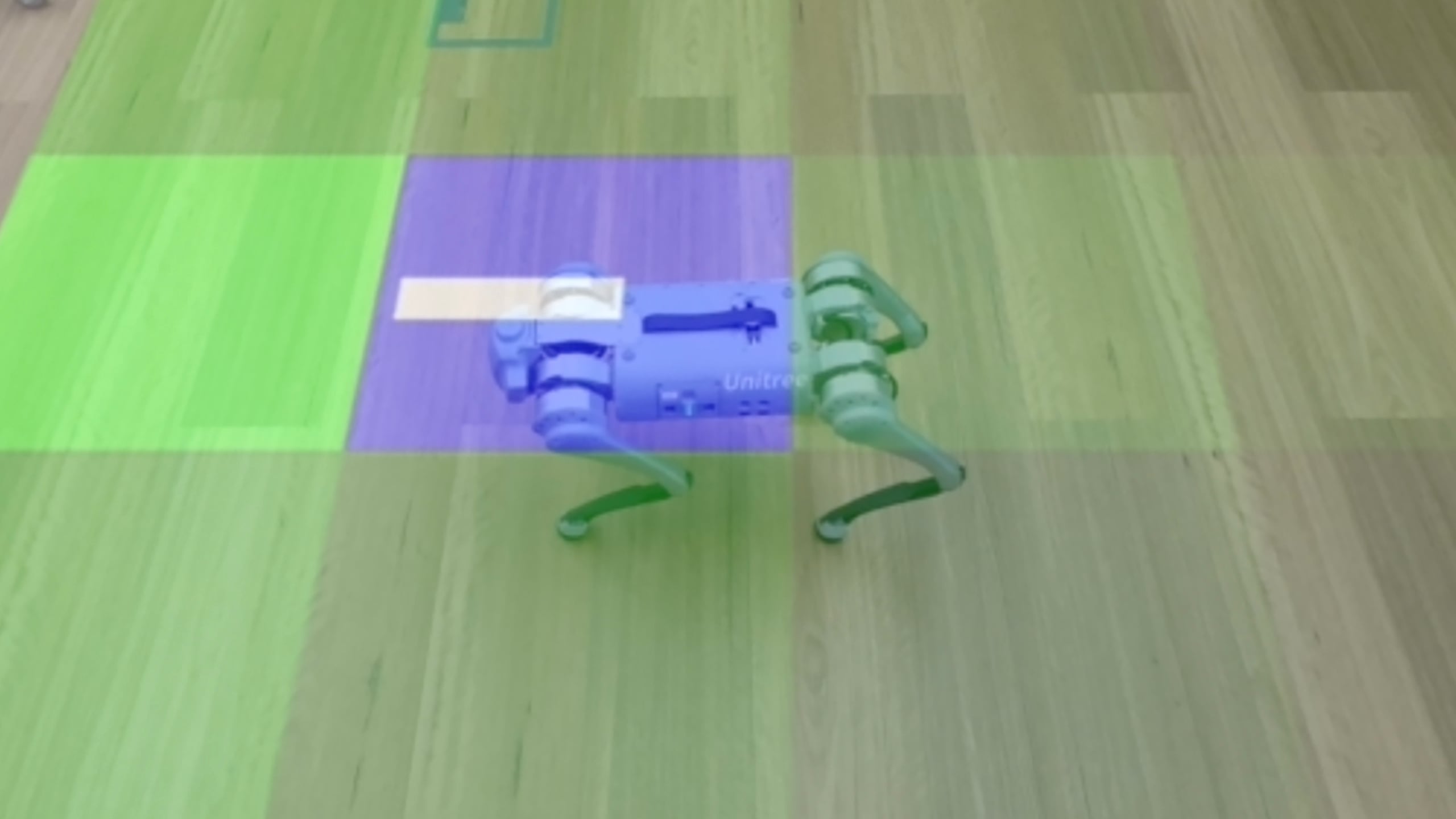
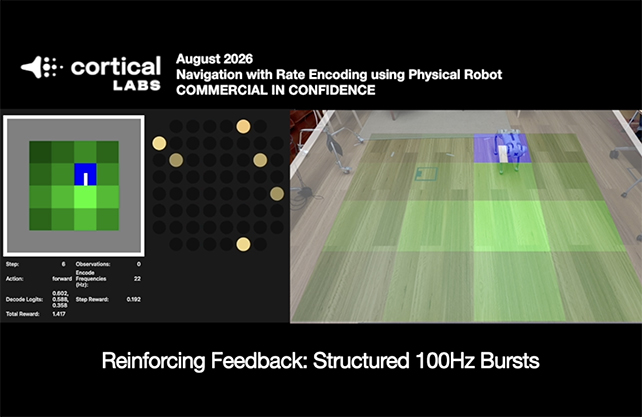
The latest demonstration of this biological technology comes from scientists at Cortical Labs in Australia, who have fitted out a robotic dog with neurons grown in the lab that are able to direct it towards a target on a simple map.
By growing the neurons right on the chip, and fitting it with electrodes that provide two-way electrical signaling, the Cortical Labs team was able to translate activity in the small group of neurons into movement for the attached robot.
“The robotic dog is a simple demonstration of how progress in biological systems can also be applied into the real world, but it helps make the opportunity tangible,” says Brett Kagan, the co-founder and CEO of Cortical Labs.
“Longer term, this approach could support robots and autonomous systems that need to make decisions in unpredictable, real-world environments.”
We’re still at the early stages of this technology – it’s not particularly fast or efficient yet – but in the future, we could see neuron-controlled robots working in remote or hazardous conditions, or assisting humans with personalized responses that learn over time.
Cortical Labs has already demonstrated clusters of neurons completing computer tasks, including playing the games Pong and Doom, and now it’s extending the idea into the physical world with robotics – and offering an alternative to traditional systems.
“Robots that are becoming remarkably capable machines at their physical control, still struggle with the higher order control required to learn quickly or adapt when conditions change,” says Kagan.
“Walking, running, and doing acrobatics is amazing, but determining where and when to do actions remains a challenge with traditional methods.”
A similar technology demonstration has also been run by Cortical Labs in partnership with Honda Research Institute Europe. In this demo, everything was run inside a virtual system, but again the aim was directing an agent around a basic grid in search of a reward.
The setup was the same, with electrical signals stimulating neurons on a chip, and the chip returning electrical messages of its own. By varying the characteristics of the electrical signal and supplying feedback on the moves of the agent, the researchers were able to train and interpret movement from the living chip.
Over more than 4,000 hours of interactions with the chip and agent, the team was able to test almost 1,300 different signal combinations.
“This research collaboration enables us to investigate fundamentally different approaches to intelligent agents,” says Daniel Tanneberg, a Senior Scientist at Honda Research Institute Europe.
“Using living cells as the core computational substrate comes with many challenges but also offers great potential in terms of energy efficiency, robustness, and adaptation – potential that we can now begin to explore and evaluate.”
There was still a fair amount of trial and error here, and the next steps are to scale up these chips to tackle more complex tasks in a shorter time – as robots out in the real world are going to need to do much more than navigate around a simple grid.
Another aim for the researchers is to learn more about how these neuron-based chips retain information, and what kind of ‘memory’ feature they might have.
“The challenge is not simply growing neurons on silicon: It is finding reliable ways to communicate with biological systems, train them and understand which approaches produce consistent results,” says Johnson Zhou, a Research Software Engineer at Cortical Labs.
“This research gives us a framework for testing those questions at scale. It establishes a foundation we can build on as biological computing moves towards practical applications.”
The navigation research has yet to be peer-reviewed but has been presented at the NeurIPS 2026 conference and is available on arXiv.
This article was fact-checked by Fiona MacDonald and edited by Fiona MacDonald. While we pride ourselves on our process, we are only human. If you spot a mistake, please let us know.