Products You May Like
My Rating
“The Plague”
The bodies lie where they fall in the streets of Varna. Bulgarian doctors insist the mysterious plague is unstoppable, while fear spreads faster than the sickness itself. The denizens of this once culturally enlightened city must remain in quarantine as police barricade every street corner, marketplace, and avenue. No one enters. No one leaves.
The rats must be responsible. What other explanation could there be? The filthy vermin infest the alleys and sewers, carrying disease wherever they scurry. Yet something about the dead troubles those brave enough to examine them. These victims have not simply succumbed to fever or infection.
What kind of rat leaves human-sized teeth marks upon the neck of its prey?
“The Long Shadow of Orloc”
The sickness has arrived upon the shores of Wisborg, Germany. The Empusa drifts into port with every member of her crew dead. A ghost ship has come home. Corpses lie scattered across the decks as if life itself had sucked them dry in a single terrible instant.
The authorities search desperately for a rational explanation. Perhaps rats carried the disease aboard. Perhaps some unknown contagion swept through the crew before they could reach land. Yet the condition of the bodies suggests something far more sinister. This was no ordinary plague carried by rat or insect.
Could the Empusa have transported something else to Wisborg? Something ancient? Something evil? To the terrified townspeople, only one explanation fits the grotesque scene aboard the vessel—a servant of Satan has come ashore, and its long shadow now stretches across the city.
“Carpe Momentum”
The world’s most coveted vampire film now rests in the hands of Hollywood’s most notorious horror movie critic. Phillip Moloch, hated throughout the industry for his merciless, no-holds-barred reviews, has spent a fortune acquiring what many believe to be the original master copy of Nosferatu.
Rumors have surrounded the 1922 film for generations. Was the original print cursed? Is the story merely Hollywood superstition passed from one frightened collector to another? Perhaps. Yet one disturbing detail refuses to disappear: everyone who has viewed this particular copy of Nosferatu has died within hours of the final credits.
Now Moloch has invited friends and colleagues to his mansion for the screening of a lifetime. The projector is ready. The lights grow dim. The film begins to roll.
Let the show begin!
Review
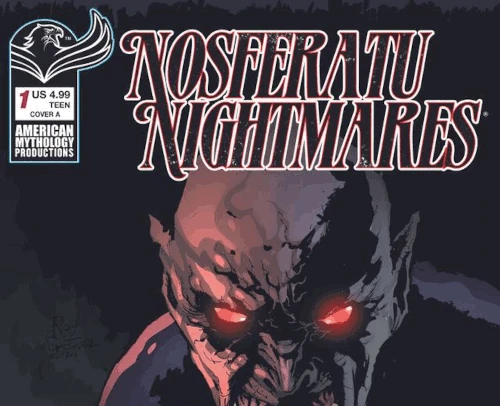
I am a fan of American Mythology Productions and have enjoyed plenty of comic books written by G.O. Parsons and S.A. Check. That makes Nosferatu Nightmares (2026) all the more disappointing. The creators pack three separate tales of vampirism, plague, and cursed cinema into this one-shot, yet they never give a single story enough room to sink its fangs into the reader. Instead of fully developed horror tales, we get interesting concepts that race toward the finish line before the terror can take hold.
In fact, this may be one of the most bare-bones excuses for storytelling I have read recently. “The Plague” and “The Long Shadow of Orloc” contain all the ingredients necessary for some wonderfully atmospheric Nosferatu horror, while “Carpe Momentum” offers a clever idea involving a cursed original print of the 1922 film. Unfortunately, each story ends just when it begins building momentum. I hate to ask it, especially considering how much I normally enjoy American Mythology’s horror comics, but was Nosferatu Nightmares simply a quick money grab?
Thankfully, artists Puis Calzada and Emanuele Tommarelli give readers something worthwhile to sink their teeth into. Their gloomy atmosphere and grotesque imagery capture the spirit of Nosferatu far better than the abbreviated stories surrounding them. The artwork easily stands as the strongest part of the entire production. I wanted to like Nosferatu Nightmares far more than I did, but even good artwork cannot put flesh onto a storytelling skeleton this thin. I give Nosferatu Nightmares two out of five stars.


