
Products You May Like
Around 7,500 spoken and signed languages are used worldwide today. Yet this extraordinary diversity may represent only a fraction of the linguistic richness humanity once possessed.
A new modeling study published in Science suggests language diversity reached a forgotten golden age between 1,000 and 3,000 years ago, when tens of thousands of languages may have coexisted.
What followed was a dramatic decline that appears to have begun long before European colonial expansion. As large states and empires grew, countless local languages may have disappeared.
Exactly how many were lost is impossible to know.
“There’s no direct evidence for language numbers until very recently,” Yale University historical linguist Claire Bowern, the study’s senior author, told ScienceAlert.
“We cannot rely on the extremely patchy records from antiquity.”
The researchers began with data from 171 mobile hunter-gatherer and fishing societies.
Their typical population sizes helped the team estimate how many ethnolinguistic groups might have existed around 12,000 years ago, at the beginning of the Holocene – the geological period that followed the last Ice Age and continues today.
At that time, the global human population is thought to have been between 4.4 million and 7 million.
“The most common feature worldwide might be a consequence of this bottleneck rather than a true reflection of what the human mind ‘prefers’. ” – evolutionary anthropologist Damián Blasi
Assuming each ethnolinguistic group – a community sharing a linguistic and cultural identity – generally spoke a distinct language, the models produced an estimate centered on roughly 4,500 to 6,200 languages.
“But because we know a lot about the relationships between languages and societies, we can use a couple of assumptions to make a simulation model of language diversification through time,” Bowern explained.
“Running that model many thousands of times gives us estimates of how languages might be evolved and split over the last 12,000 years.”
As agriculture supported population growth, communities could split and develop distinct languages. At the same time, societies grew larger, allowing increasing numbers of people to share the same language.
Despite uncertainty over the balance between these forces, the model produced a similar pattern: Language diversity rose through much of the Holocene, generally peaked around 2,000 years ago, and then rapidly declined.
“Such a model has many gaps, of course, but it provides us with an estimate that future work can further refine,” she said.
“Each assumption makes the modeling more tractable, but there’s a lot that we can’t know,” Bowern said.
“For example, the timing of agricultural shifts happens at different times in different places, and large-scale population replacements would have a big effect on language richness. We didn’t include any local factors like that in the models.”

1. A rollout of the San Andrés cylinder seal, showing the bird possibly “speaking” the name “3 Ajaw” in Olmec hieroglyphs. (Madman2001/Wikimedia Commons/CC BY-SA 3.0)
2. Lemnian language inscription. (Giovanni Dall’Orto/Wikimedia Commons)
3. Tartessian language. (Vitor Oliveira from Torres Vedras, PORTUGAL/Wikimedia Commons/CC BY-SA 2.0)
4. Urartian text. (EvgenyGenkin/Public Domain/Wikimedia Commons)
5. Rhaetic inscription on bronze: Large Sanzeno alphabet. (Andreas Blaickner/CC BY-SA 3.0/Wikimedia Commons)
6. Proto-Elamite tablet found at Tepe Yahya. (Jerónimo Roure Pérez/CC BY-SA 4.0/Wikimedia Commons)
7. The Pyrgi Tablets, sheets of gold with a bilingual treatise in Etruscan (center and right) and Phoenician, at the
Etruscan Museum in Rome. (Sailko/CC BY-SA 4.0/Wikimedia Commons)
8. The Drosten Stone (Pictish). (Edward Williams Byron Nicholson/Public Domain/Wikimedia Commons)
9. Uxama tessera, Celtiberian script (Omsa, Soria). (Carlosblh/CC BY-SA 3.0/Wikimedia Commons)
10. The Phaistos disc (side B). (Gleb Simonov/Public Domain/Wikimedia Commons)
11. The hand of Irulegi. (Nafarroako Gobernua//CC BY-SA 3.0/Wikimedia Commons)
The timing of the overall decline points towards the expansion of early states and empires.
“The strongest evidence is the timing of the decline,” Bowern said.
“We examined many variants of the models, and they all show a similar trajectory.
“This also fits well with what we do know from the historical record. The record is very patchy and incomplete, but we do know of examples of ancient language shift and the replacement of local languages by more regional ones.”
The implications extend beyond reconstructing the past.
Today’s languages emerged from a historical bottleneck in which major losses left only a fraction of the original diversity intact. This may distort what scientists consider universal or “natural” features of human language.
Researchers have interpreted features shared by many languages as clues to preferences in the human mind. If most languages place the subject at the beginning of a sentence, that may suggest humans prefer subjects to appear early.

But the study’s first author, evolutionary anthropologist Damián Blasi of the Catalan Institution for Research and Advanced Studies, says this historical loss complicates that reasoning.
“What we show is that the shake-off of language diversity has taken place so recently in time and so substantially that whatever ends up as the most common feature worldwide might be a consequence of this bottleneck rather than a true reflection of what the human mind ‘prefers’,” Blasi told ScienceAlert.
“Practically, this means that invoking ‘naturalness’ or whatever is most common is not a faithful guide to our scientific understanding of language.”
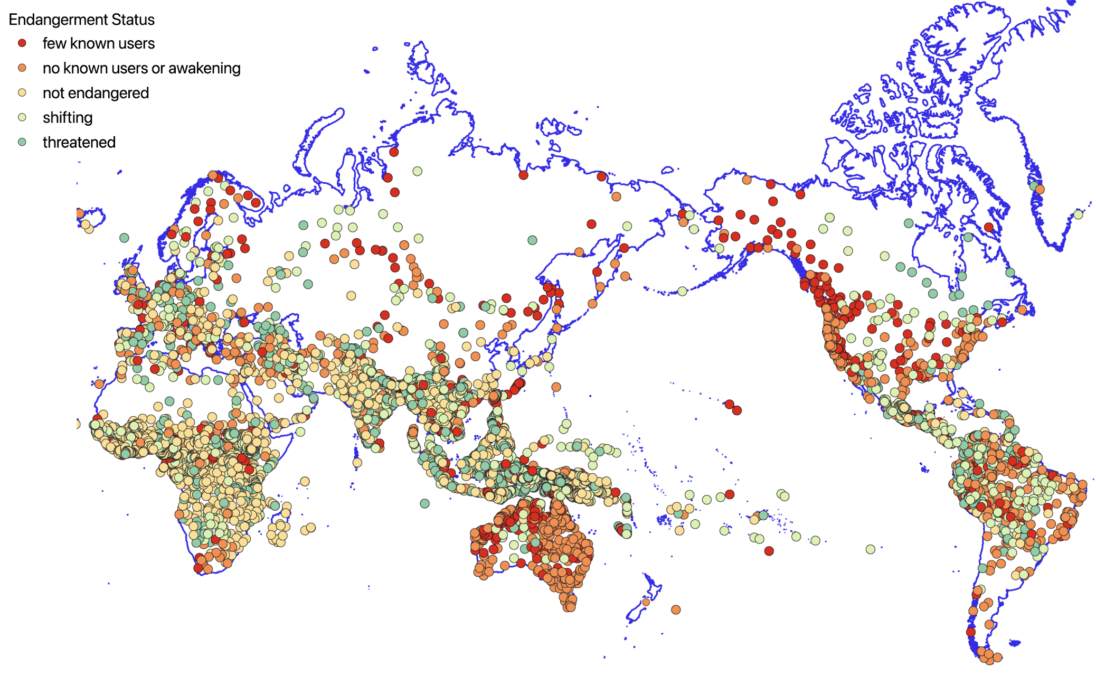
Many languages whose lineages predate these historical expansions are now endangered.
Related: Your Brain Really Can Learn to Multitask – And Scientists Just Revealed How
The decline is far from over.
A 2022 study published in Nature Ecology & Evolution, which analyzed 6,511 spoken languages, predicted that without intervention, language loss could triple within 40 years, with more than 1,500 languages lost by the end of the century.
“This modeling shows that we need to pay close attention to the languages whose lineages predate these spreads,” Bowern said.
“Many of those languages are under threat, but language loss is not inevitable, and we have many tools for language support today that weren’t around 3,000 years ago!”
The study was published in Science.
This article was fact-checked by Rebecca Dyer and edited by Rebecca Dyer. While we pride ourselves on our process, we are only human. If you spot a mistake, please let us know.