Products You May Like
Nearly 25 years on from its release, Mass Effect can feel like a forgotten relic. The game’s achievements as a character-driven space opera have been appropriated by its immediate successor, Mass Effect 2, leaving behind a reputation for clunky combat and awkward driving segments (see ‘Mako or break’). 2021’s Legendary Edition remaster attempted to conceal its many blemishes while collecting the trilogy in one package – and in doing so, highlighted the gulf in quality between games one and two.
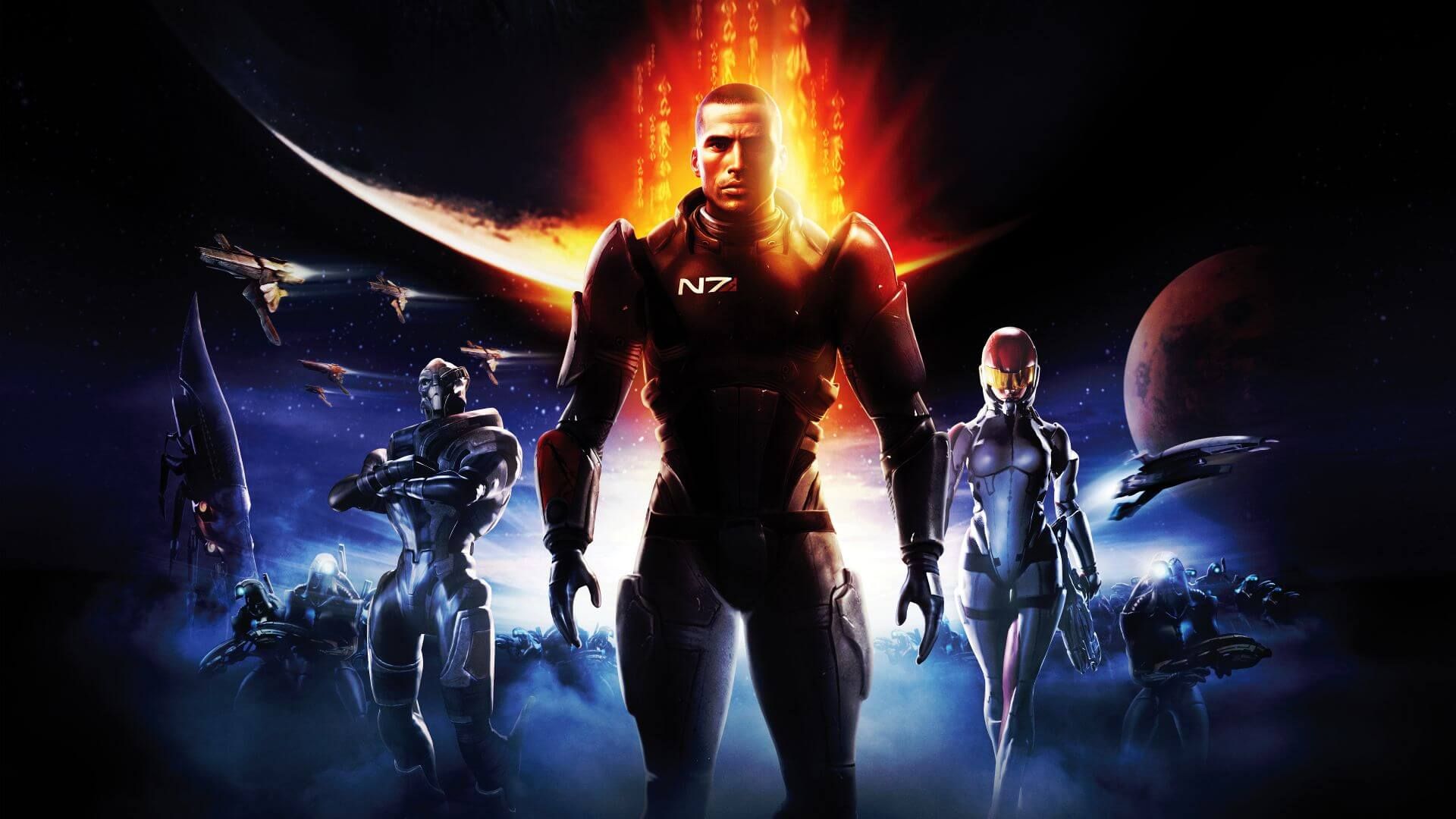
But the dented legacy of the 2007 original, first released as an Xbox 360 exclusive, doesn’t do it justice. Mass Effect remains a special game, with flaws that aren’t as obvious as you remember and a setting to match any that BioWare has created. Yes, the second game’s ensemble cast will always be the series standout, but Mass Effect built a believable galaxy for those characters to live in, home to trillions of inhabitants and dozens of races. Without that history, you wouldn’t understand the motivations of your Mass Effect 2 companions, or care about their collective fate. And in some ways Mass Effect betters the games that came after it – certainly, at least, with its hub world, the Citadel.
My favorite store on the Citadel!

Commander Shepard, your customised avatar, first arrives here to report the betrayal of Saren, a member of the elite force known as the Spectres, which operates above the law at the will of the intergalactic Council. The Citadel is a megaship positioned right at the heart of the galaxy, a five-armed monolith that is home to the Council and to 12 million people besides: the kind of location that would’ve been difficult to depict in any detail on screen in the mid2000s. BioWare didn’t try to build a giant city that looks believable, as Rockstar would with GTA 4’s open world a year later. Rather, it built a world that feels believable.
Latest Videos FromGamesRadar+
The twinkling urban sprawl you see when you look out of the curved windows lining the Citadel’s corridors is mere set dressing, not intended to truly fool you. None of the sections it is carved up into is especially large or bustling – but they are all distinct, in ways that leave room for you to imagine what might happen when you’re not around. The cavernous Presidium is a marvel of sterile grandeur, its simulated blue sky, trimmed trees and white fountains forming the kind of characterless utopia in which smiling ambassadors of each species would want to operate. In contrast, Flux, the nightclub down in the Wards, the “cultural heart of the galaxy”, flashes with neon lights and pulses with music while patrons mingle at tables or at the bar, and others try their luck on arcade machines upstairs.

BioWare deploys multiple tricks to make these spaces feel bigger than they actually are. Corridors have multiple nooks with no apparent purpose, or which are only used for a specific sidequest, while aliens tap away at banks of computers in side rooms, their purpose unknown. Walkways crisscross and overlap, and elevator rides – infamously – take an eternity, during which you listen to news reports about humanity’s efforts to colonise distant planets.
But the characters are what really sell the idea that both the Citadel and the galaxy beyond are bigger than what actually exists on your hard drive. The line of embassies and administrative offices you find in the Presidium are an excuse to meet a variety of alien races: the polite Elcor, who preface their words with a summary of what they’re about to say, and the diminutive Volus, who specialise in commerce and are bitter that they lack a seat at the Council. The way you learn about their cultures feels contrived (Shepard will say, straightfaced, “Tell me about Volus culture”), but the answers speak to a universe of varied environments, economies and political systems.

Your crewmate companions are in on it too. Enter Flux with Wrex, your Krogan companion, and he’ll comment how “places like this” always want to hire Krogan bouncers, “like we’re a status symbol for them”, which reveals something about both Citadel and Krogan life. When Garrus, a humanoid Turian, meets a gambler who has been kicked out of the club, his statement that if Doran, its Volus owner, “says you’re cheating, you’re cheating” suggests that he has visited countless times before. Walk past a Krogan statue, gleaming white in the Presidium, and Wrex will begin arguing with Garrus about the violent reputation of his species, and about the genophage, a biological weapon deployed by the Turians to wipe out the Krogan after a decades-long war – a topic that’s repeated in multiple quests and creates an underlying tension within your squad.
It’s a technique not dissimilar to the ‘iceberg theory’ of storytelling associated with the writer Ernest Hemingway, which holds that the sparse, surface elements of a story should hint at vast, deeper meaning below. Here, the technique is used for worldbuilding: the Citadel is the tip of the iceberg, a snapshot of the numerous alien races in the galaxy that speaks to a vast world beyond.
We have no beginning. We have no end. We are infinite.

It’s a philosophy that continues when you leave the Citadel and head for your next destination, using a vast map. The overarching plot – chasing Saren across the galaxy, with the fate of civilisation in your hands – feels like standard science-fiction fare, but it’s split into missions that provide self-contained stories about people and places, each one sketching in more detail about the universe you’re moving through. When trying to track down Saren on Feros, a colony world run by the ExoGeni Corporation, you learn about the exploitative relationship between people and business while helping settlers with shortages of food, water, and power. On Noveria, you discover – and decide the entire fate of – the Rachni, an insectoid species believed extinct.
This achievement dwarfs the actual roleplaying, which doesn’t stand up too well to modern examination. Mass Effect’s dialogue wheel promised to steer away from binary good and bad, but instead created a morality-by-menu that lets you swing wildly between space racist and compassionate empath. Some of the ‘renegade’ dialogue options are ridiculous, such as being able to punch a reporter on camera, out of nowhere, after she asks perfectly reasonable questions. The writing that underpins it is occasionally stiff, too. We don’t need to be told that “shooting people isn’t always the answer” after defusing a tense situation in the gentleman’s club Chora’s Den, for example, and some jokes, including an early one about how “size isn’t everything”, fall flat.

Perhaps the part of Mass Effect that has been most maligned over the years, though, is its combat. In truth, it’s perfectly passable, even 15 years on. Put side-by-side with Mass Effect 2, it’s admittedly clunky: weapons overheat quickly and sometimes don’t shoot straight; Shepard rarely sticks to cover; your abilities and ‘first aid’ heal recharge slowly, slowing the pace of fights. But once you accept these limitations, firefights turn into challenging puzzles where solutions can be invented in the moment, pausing combat to conduct your squad’s arsenal of explosive powers.
The best of these are biotics – explained away as a result of the titular energy fields, but in essence Mass Effect’s equivalent of the magic systems found in BioWare’s fantasy games, or the Force abilities offered by Knights Of The Old Republic. The two classes that can use biotics – Adept, a purist, or Vanguard, which sacrifices some biotic power for shotgun skills – are effectively space wizards, able to suck enemies into a swirling blue vortex or tug them out of cover and into the air, where they hang suspended as target practice for the rest of the squad.
The makeup of that squad is essential to making the most of Mass Effect’s combat. It’s telling that only one of the characters on offer, Ashley Williams, is a pure soldier, as if the game is trying to push you away from relying on guns, knowing how quickly it will get repetitive. Better to choose the pairing of Garrus and Wrex, who can combine biotics with tech explosions triggered by Garrus’s omni-tool, and dive into another of Mass Effect’s strengths: character customisation. This stretches beyond picking guns and powers, into weapon attachments and ammo types that can completely change the way you play. Level up Wrex’s biotic barrier skill, and he can be directed to rush in solo, tanking damage while tearing through shields with phasic ammo, before pausing to line up Garrus’ sniper Assassination skill.

This customisation is lost somewhat in Mass Effect 2’s streamlining of the design. It’s missed, but not as much as the Citadel, to which we can’t help but return after every main mission, just to see what’s different. The sequel’s version is a shrunken, more static hub, but here, on every visit, enough has changed to give the illusion that this is a dynamic, evolving place in which NPCs come and go. Side missions zigzag between the financial district and Chora’s Den, each unlocking new dialogue options with existing characters, or revealing a new secret about Citadel life.
Returning to the med clinic, where an early story mission takes place, you’ll find a doctor who’s being blackmailed by a Krogan in the Citadel’s markets. Scaring the Krogan off reveals a mystery about a “classified project” in a far-off system – a plotline which doesn’t resolve until Mass Effect 3. This should be how Mass Effect is remembered: not as a rough draft, but as a remarkable act of scene-setting, making promises for future games to fulfil and building a believable stage on which one of gaming’s greatest science-fiction series could play out.
This Mass Effect article was first published in issue 373 of Edge Magazine. To get more like this delivered straight to your doorstep (or digital device) consider subscribing to Edge.