
Products You May Like
CAPE CANAVERAL, Fla. (AP) – A NASA spacecraft chasing a rare metal asteroid swings past Mars this week for a gravity boost, snapping thousands of pictures as practice for the main encounter in 2029.
Named Psyche, like the asteroid it’s after, the robotic explorer will slingshot past the red planet at 12,333 mph (19,848 kph) on Friday 15 May.
It will be an especially close flyby, with Psyche passing within 2,800 miles (4,500 kilometers) of Mars, equivalent to the distance between the US east and west coasts.
Then it will barrel toward the asteroid belt between Mars and Jupiter, which is home to its enticing target.
 frameborder=”0″ allow=”accelerometer; autoplay; clipboard-write; encrypted-media; gyroscope; picture-in-picture; web-share” referrerpolicy=”strict-origin-when-cross-origin” allowfullscreen>
All of the spacecraft’s science instruments will be on for the Mars pass.
NASA’s two Mars rovers, along with a small fleet of US and European orbiters, will make surface and atmospheric observations at the same time for comparison.
Psyche’s cameras already are photographing Mars, appearing as a crescent on approach and a nearly full sphere once it’s in the rearview mirror.
The different views will serve double duty, allowing operators to fine-tune their instruments while providing “just plain beautiful photos,” Arizona State University’s Jim Bell, the imaging team leader, said in a statement.

While the asteroid belt is swarming with millions of objects, most are made of rock or ice.
Only a small percentage are thought to be metal-rich like Psyche, a potato-shaped asteroid roughly 173 miles long and 144 miles wide (278 kilometers by 232 kilometers).

Scientists suspect the asteroid may be the exposed nickel-and-iron core of a fledgling planet that was stripped down by cosmic collisions.
Studying such an object up close can yield information about the dawn of our solar system 4.6 billion years ago, and why and how Earth spawned life.
Related: How Feasible Is Asteroid Mining? A New Study Investigates
Launched in 2023, the spacecraft is midway through its six-year round-trip journey to Psyche in the outer fringes of the asteroid belt, three times farther from the sun than Earth.
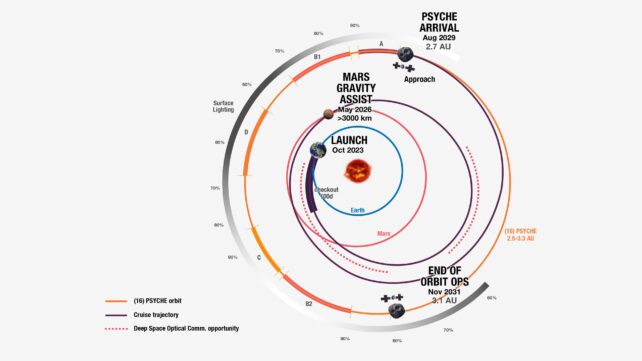
It should arrive in 2029, slipping into orbit around the asteroid for two years of study.
The van-sized spacecraft runs on solar electric propulsion, using xenon gas thrusters.
You can read more about the Psyche mission here.