Products You May Like
You might have read somewhere that in ancient Egypt, royalty were often buried with people sacrificed to serve them in the afterlife, but archaeologists aren’t actually so sure about that.
When British Egyptologist Flinders Petrie excavated graves surrounding the tombs of ancient Egyptian First Dynasty kings in the 1920s, he found the remains of many more people – hundreds, in some cases.
At the time, he suspected the people in these satellite graves could have been sacrificed shortly after each king’s death, in what is known as a retainer sacrifice.
But Petrie was unable to find evidence for how these people died, a gap that has left this theory open to doubt.
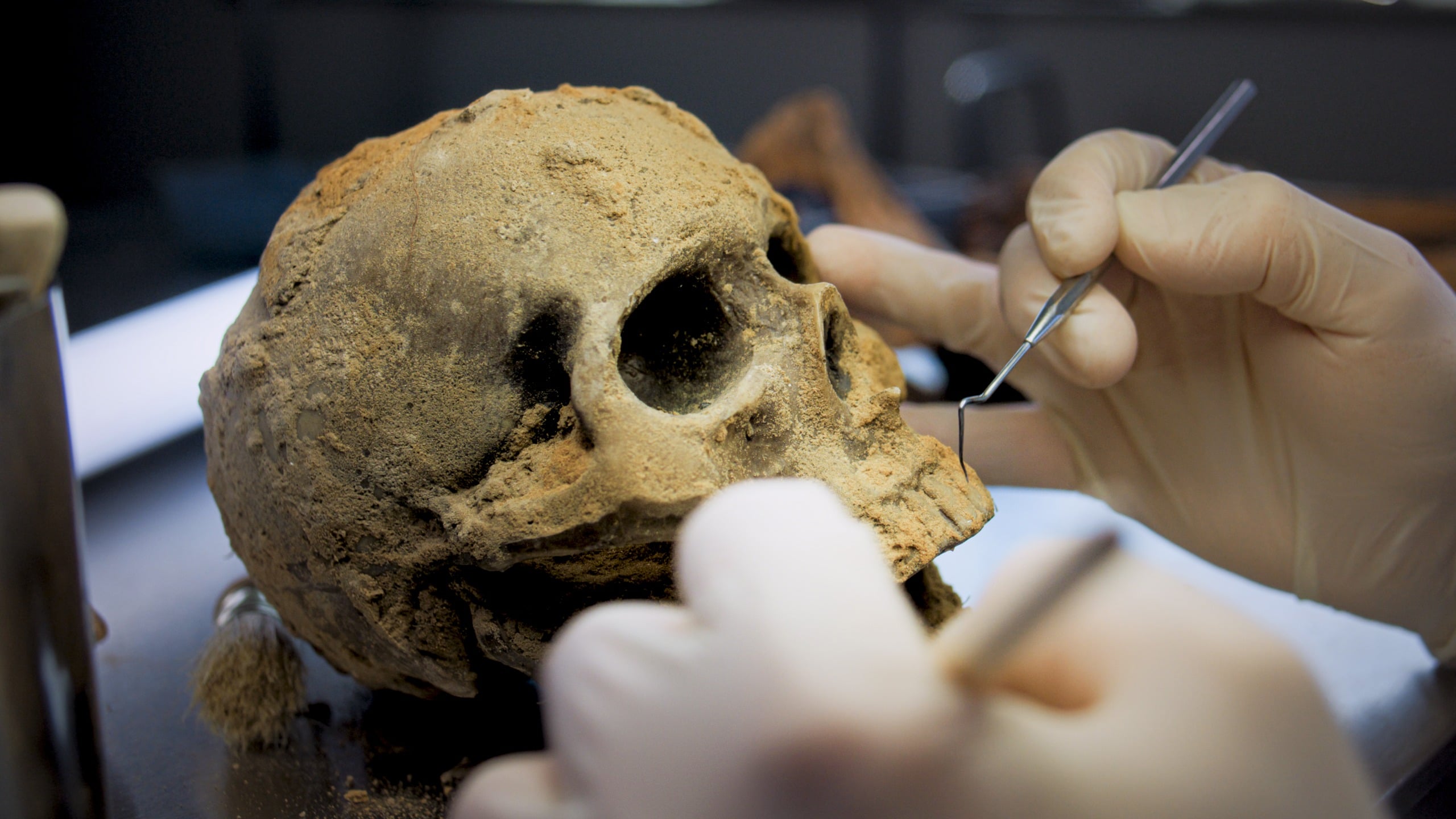
Archaeologist Roselyn Campbell, of Purdue University in the US, has been revisiting Petrie’s work with a modern forensic approach, confirming that 18 of the 46 skulls Petrie preserved and brought back to England show signs of potentially lethal injuries.
She presents her findings in a new paper, published today in Frontiers in Environmental Archaeology.
These skulls were unearthed from around the royal funerary complexes at Umm el-Qaab in ancient Abydos, where they were interred near ancient Egypt’s first kings. These First Dynasty leaders ruled from around 3078 to 2900 BCE.
 frameborder=”0″ allow=”accelerometer; autoplay; clipboard-write; encrypted-media; gyroscope; picture-in-picture; web-share” referrerpolicy=”strict-origin-when-cross-origin” allowfullscreen>
Some of the graves surrounding the royal burials were marked with names and official titles, identifying them as lower- or mid-level officials, or artisans.
“Each subsidiary burial was a simple chamber in a row of dozens of others,” says Campbell.
“Some people had a simple coffin. Most people had a few grave goods, like ceramic vessels, and many graves also included small objects like copper tools, projectile points, or small ivory figurines.”
Campbell has been re-analyzing the skulls of these ancient Egyptian civilians for several years.
Linear fractures across the skullcap are the most common injuries she has found – a kind of damage that is usually caused by flat, wide objects.
In a few of the skulls, Campbell also found sharp force injuries, including “a penetrative injury to the side of the head” and “a chopping injury to the eye”.
“While it is certainly possible that some individuals may have died peacefully from some other cause and been buried around the royal funerary complexes, it is also clear that many of these individuals did experience perimortem trauma of some kind,” Campbell writes.
In other words, it’s quite likely that these subjects were killed deliberately, by traumatic blows to the head.
“Petrie believed that the closure of so many graves at once made individual interments after natural deaths unlikely, and the apparently hasty closure of so many tombs along with the identity of officials associated in some way with the royal court led him to conclude that these burials probably represented retainer sacrifice,” Campbell writes.
Her findings lend further credence to Petrie’s theory: that the people in these subsidiary burials may have been sacrificed when their king died, with the belief that they would serve their ruler in the afterlife.
If so, it also seems this practice started very early in the culture of ancient Egypt.
“Some retainers might have volunteered to die to achieve eternal life or honor, others may have been chosen or even forced,” Campbell suggests.
“If I had unlimited resources, I would love to figure out where the bodies of these individuals might be and analyze them!
“Still, this study shows how much new information about the past can be revealed when we revisit previous data armed with updated methods and knowledge, even for datasets that are incomplete and imperfect like this one.”
The research has been published in Frontiers in Environmental Archaeology.
This article was fact-checked by Rebecca Dyer and edited by Rebecca Dyer. While we pride ourselves on our process, we are only human. If you spot a mistake, please let us know.