Products You May Like
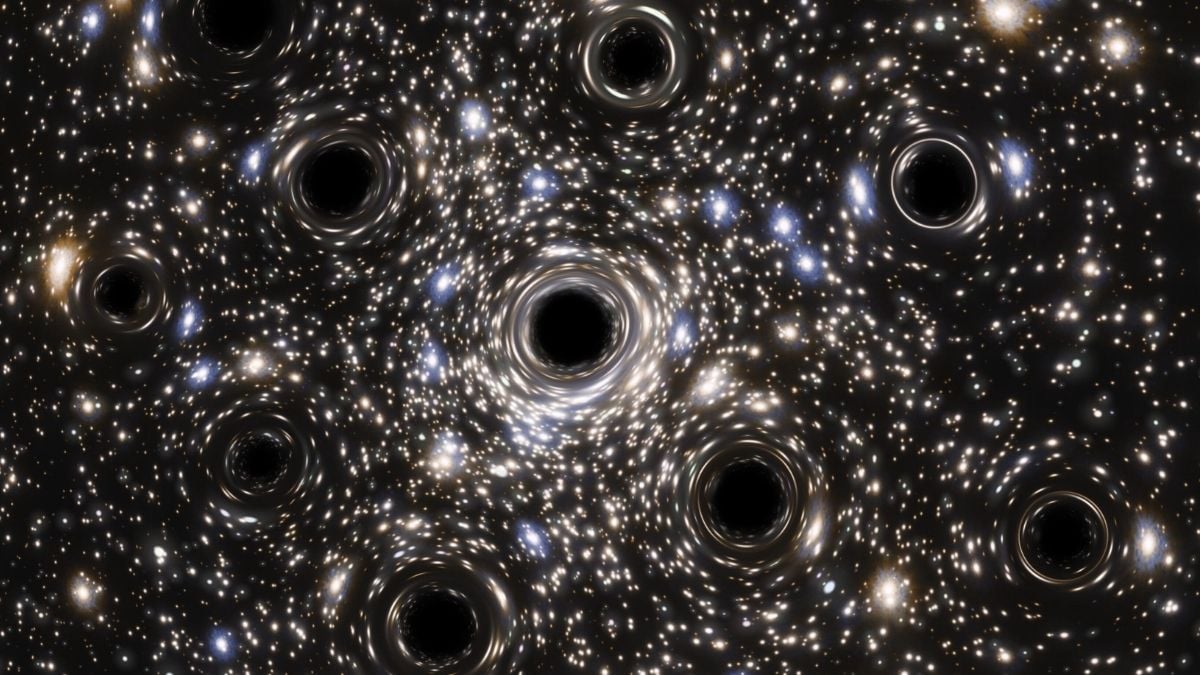
Somewhere in the future, there’s a finish line in the marathon to understand supermassive black holes (SMBHs).
We can’t say how close we are, or what the final results will be. But astrophysicists keep going, confident that with each passing landmark, the finish draws nearer.
Working with the JWST, researchers have now found a SMBH with 50 million solar masses that appears to predate its host galaxy.
This discovery is a direct challenge to what we thought we know about SMBHs.
Astrophysicists understood, or thought they understood, that SMBH growth goes something like this: a massive star in a galaxy collapses into a black hole at the end of its life.
This stellar-mass black hole grows by accreting surrounding material, and by merging with other stellar mass black holes doing the same thing.
Galaxies also merge, driving their black holes to merge with them. Eventually, the process creates large galaxies with SMBHs that can have billions of solar masses.
It was still somewhat mysterious how small stellar mass black holes could be the seeds for much more massive SMBH, but the basic process was outlined.
Or so it was thought.
But now that the JWST has found a SMBH that appears to predate its galaxy, new questions demand answers.
“This is a remarkable finding. It’s a paradigm shift, a total revisiting of the classical scenarios of how black holes form and grow.” – Roberto Maiolino, Kavli Institute.
Two new papers present the discovery. One is “A direct black-hole mass measurement in a little red dot at high redshift,” published in Nature. The lead author is Ignas Juodžbalis from the Kavli Institute for Cosmology, at the University of Cambridge in the UK.
The other is “A black hole in a near pristine galaxy 700 Myr after the big bang,” and it’s published in the Monthly Notices of the Royal Astronomical Society. The lead author is Roberto Maiolino, also from the Kavli Institute at Cambridge. The lead authors of both papers are also co-authors on the other paper.
“This is a remarkable finding,” Maiolino said in a press release.
“It’s a paradigm shift, a total revisiting of the classical scenarios of how black holes form and grow.”
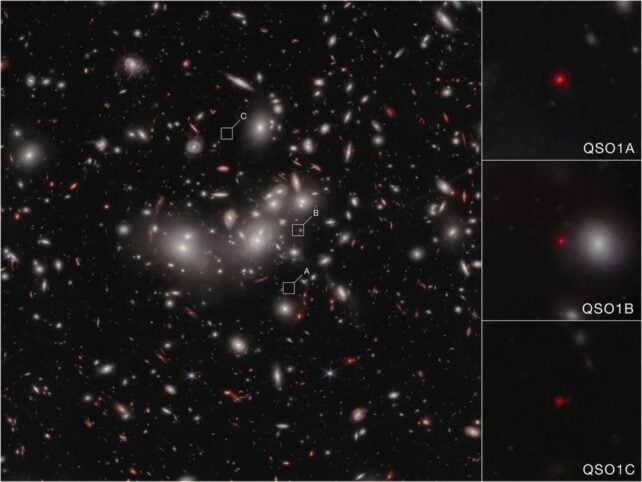
The finding arises from the observations of Abell2744-QSO1, a prototypical Little Red Dot (LRD) from only 700 million years after the Big Bang.
Despite its small size, only 1,300 light years across, the LRD is accessible to detailed observations.
That’s because it’s gravitationally lensed by galaxy cluster Abell 2744, also known as Pandora’s Cluster. The lensing both magnifies QS01 and triples it.
Prior to this work, initial observations showed that QS01 was no more than a cloud of gas with a 40 million solar mass SMBH.

Its mass measurement wasn’t certain because astronomers weren’t accustomed to finding such massive SMBHs so early in the Universe.
“Before now, all of the mass measurements of black holes in the early Universe have been indirect, based on assumptions from what we know about them in the local Universe. We didn’t know if those assumptions really apply to the distant Universe,” said co-author Francesco D’Eugenio, also of Cambridge University.
If the SMBH was that massive, then it should be affecting the surrounding gas in a measurable way.
Researchers used the integrated field unit on the JWST’s NIRSpec to determine the SMBH’s gravitational effect on the surrounding gas, and to map the various elements present in it.
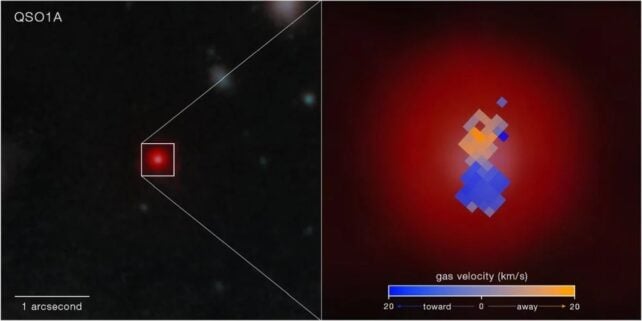
The measurements revealed that the SMBH was 50 million solar masses, 10 million more than thought. The measurements also revealed something else: the SMBH makes up a massive portion of the galaxy’s mass, something we don’t see in galaxies in the local Universe.
“QSO1 lies orders of magnitude above the local scaling relations and is approximately 1 dex more overmassive than even the most extreme sources found by JWST so far,” the authors write in the first paper.
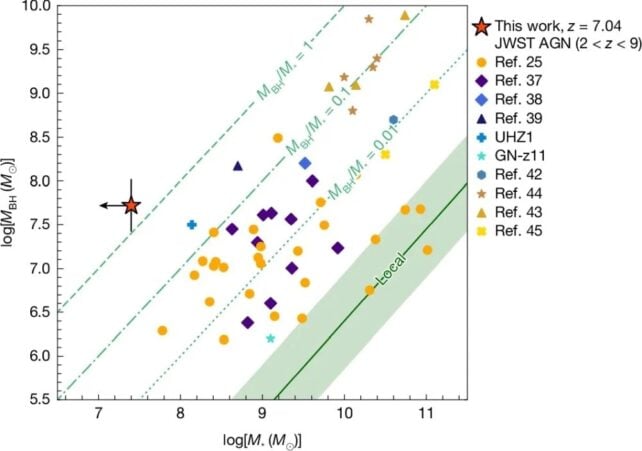
“It is challenging for most models to account for such a chemically unevolved system that host a BH that is already so massive,” the authors explain in the second paper.
Related: Spacetime ‘Crystals’ Could Collapse Into Tiny Black Holes, Wild Paper Explains
“This is a phenomenal result,” said Maiolino.
“It is the first direct measurement of a black hole mass within the first billion years after the Big Bang, and it is consistent with the previous measurements.”
Even though the new measurements show it has 50 million solar masses rather than 40 million, that doesn’t materially change the JWST’s findings of massive SMBHs so early in the Universe.
But it does provide proof that black holes don’t grow in the orderly, hierarchical way that astrophysicists thought they did.
This article was originally published by Universe Today. Read the original article.