Daily Geek Report
  • Home
  • Tech
  • Science
  • Games
  • Comics
  • Action Figures/ Toys
  • Movies
  • Books
  • Horror
  • Television
  • Music
  • Cover Story
  • Contact
    • About us
    • Amazon Disclaimer
    • DMCA / Copyrights Disclaimer
    • Privacy Policy
    • Terms and Conditions
Skip to content
Daily Geek Report
The #1 Source For All Things Geek
  • Tech
  • Science
  • Games
  • Comics
  • Action Figures/ Toys
  • Movies
  • Books
  • Horror
  • Television
  • Music
  • Cover Story
  • Contact
    • About us
    • Amazon Disclaimer
    • DMCA / Copyrights Disclaimer
    • Privacy Policy
    • Terms and Conditions

Superconductivity Model With 100,000 Equations Now Contains Just 4 Thanks to AI

September 28, 2022 by Admin 0 Comments

Science

Products You May Like

Ads by Amazon
Share on Facebook
Share on Twitter
Share on Pinterest
Share on LinkedIn

Electrons whizzing through a grid-like lattice don’t behave at all like pretty silver spheres in a pinball machine. They blur and bend in collective dances, following whims of a wave-like reality that are hard enough to imagine, let alone compute.

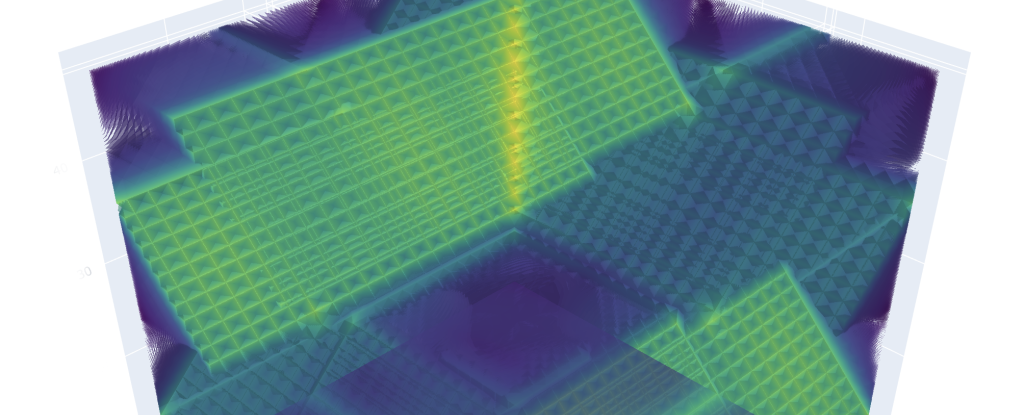
And yet scientists have succeeded in doing just that, capturing the motion of electrons moving about a square lattice in simulations that – until now – had required hundreds of thousands of individual equations to produce.

Using artificial intelligence (AI) to reduce that task down to just four equations, physicists have made their job of studying the emergent properties of complex quantum materials a whole lot more manageable.

In doing so, this computing feat could help tackle one of the most intractable problems of quantum physics, the ‘many-electron’ problem, which attempts to describe systems containing large numbers of interacting electrons.

It could also advance a truly legendary tool for predicting electron behavior in solid state materials, the Hubbard model – all the while bettering our understanding of how handy phases of matter, such as superconductivity, occur.

Superconductivity is a strange phenomenon that arises when a current of electrons flow unimpeded through a material, losing next to no energy as they slip from one point to another. Unfortunately most practical means of creating such a state rely on insanely low temperatures, if not ridiculously high pressures. Harnessing superconductivity closer to room temperature could lead to far more efficient electricity grids and devices.

Since achieving superconductivity under more reasonable conditions remains a lofty goal, physicists have taken to using models to predict how electrons could behave under various circumstances, and therefore which materials make suitable conductors or insulators.

These models have their work cut out for them. Electrons don’t roll through the network of atoms like tiny balls, after all, with clearly defined positions and trajectories. Their activity is a mess of probability, influenced not only by their surroundings but by their history of interactions with other electrons they’ve bumped into on the way.

When electrons interact, their fates can become intimately intertwined, or ‘entangled‘. Simulating the behavior of one electron means tracking the range of possibilities of all electrons in a model system at once, which makes the computational challenge exponentially harder.

The Hubbard model is a decades-old mathematical model that describes the confusing motion of electrons through a lattice of atoms somewhat accurately. Over the years and much to physicists’ delight, the deceptively simple model has been experimentally realized in the behavior of a wide array of complex materials.

With ever-increasing computer power, researchers have developed numerical simulations based on Hubbard model physics that allow them to get a grip on the role of the topology of the underlying lattice.

In 2019, for instance, researchers proved the Hubble Model was capable of representing superconductivity higher-than-ultra-cold temperatures, giving the green light to researchers to use the model for deeper insights into the field.

This new study could be another big leap, greatly simplifying the number of equations required. Researchers developed a machine-learning algorithm to refine a mathematical apparatus called a renormalization group, which physicists use to explore changes in a material system when properties such as temperature are altered.

“It’s essentially a machine that has the power to discover hidden patterns,” physicist and lead author Domenico Di Sante, of the University of Bologna in Italy, says of the program the team developed.

“We start with this huge object of all these coupled-together differential equations” – each representing pairs of entangled electrons – “then we’re using machine learning to turn it into something so small you can count it on your fingers,” Di Sante says of their approach.

The researchers demonstrated that their data-driven algorithm could efficiently learn and recapitulate dynamics of the Hubbard model, using only a handful of equations – four to be precise – and without sacrificing accuracy.

“When we saw the result, we said, ‘Wow, this is more than what we expected.’ We were really able to capture the relevant physics,” says Di Sante.

Training the machine learning program using data took weeks, but Di Sante and colleagues say it could now be adapted to work on other, tantalizing condensed-matter problems.

The simulations thus far only capture a relatively small number of variables in the lattice network, but the researchers expect their method should be fairly scalable to other systems.

If so, it could in the future be used to probe the suitability of conducting materials for applications that include clean energy generation, or to aid in the design of materials that may one day deliver that elusive room-temperature superconductivity.

The real test, the researchers note, will be how well the approach works on more complex quantum systems such as materials in which electrons interact at long distances.

For now, the work demonstrates the possibility of using AI to extract compact representations of dynamic electrons, “a goal of utmost importance for the success of cutting-edge quantum field theoretical methods for tackling the many-electron problem,” the researchers conclude in their abstract.

The research was published in Physical Review Letters.

Share on Facebook
Share on Twitter
Share on Pinterest
Share on LinkedIn

Products You May Like

Ads by Amazon

Articles You May Like

The Weeknd Debuts New Song Sampling Neon Genesis Evangelion Theme
I’m Glad World War Z Is Getting A Sequel, But The Book Still Needs A Proper Adaptation
“Lynchian Meets Lovecraftian” In 48-Episode Horror Series That Broke The Genre’s Rules
Book review of The Nightingales by Emil Wilson
Bullet For My Valentine return with ferocious single ‘Social Apocalypse’ from first album in over five years

Search Box

Recent Articles

  • Todd Rundgren claims that Taylor Swift “ruined music” and calls her the “apotheosis of mediocrity”
  • Ubisoft: Rayman Legends Retold at launch includes map, lithographs, slipcase & Rayman Origins Enhanced
  • Godzilla Minus Zero review: “Easily one of the best films of the year”
  • Historical Charms Officially Announced For October 2026
  •  ‘Interview with the Vampire’ Director Talks Anne Rice & Lestat
  • Book Riot’s Deals of the Day for September 26, 2026
  • All Things Go, CBGB, Global Citizen 2026 Festivals Canceled
  • The Video Games And More You Should Play This Weekend – September 25, 2026
  • ‘Avengers Endgame’ Leads Weekend Where Four Films Eye $20M+ Each
  • 11 Horror Movies Where the Sound Is Scarier Than the Monster

Tech

  • Will AI Kill Us?Will AI Kill Us?
  • Will AI Kill Us?Will AI Kill Us?
  • ARCANA LABS AI IS REWRITING HOLLYWOOD — ONE TOOL AT A TIMEARCANA LABS AI IS REWRITING HOLLYWOOD — ONE TOOL AT A TIME
  • Howard Bloom: The IncomparableHoward Bloom: The Incomparable
  • The Material Power of Immaterial Things By Howard BloomThe Material Power of Immaterial Things By Howard Bloom
  • Allan Klepfisz, Global CEO of FENIX360: Empowering Creativity in a Challenging WorldAllan Klepfisz, Global CEO of FENIX360: Empowering Creativity in a Challenging World
  • WhatsApp Rolls Out Safety Overview Which Lets You Review Group Information for Protection Against ScamsWhatsApp Rolls Out Safety Overview Which Lets You Review Group Information for Protection Against Scams

Categories

  • Action Figures/ Toys (1,734)
  • Books (1,911)
  • Comics (3,186)
  • Cover Story (22)
  • Events (21)
  • Games (6,880)
  • Horror (5,526)
  • Interviews (63)
  • Movies (6,773)
  • Music (6,842)
  • News (154)
  • Politics (6)
  • Science (6,048)
  • Tech (3,405)
  • Television (2,807)
  • Uncategorized (10)

Action Figures / Toys

  • REVIEW: Marvel Legends Future Foundation Invisible Woman
  • Hasbro Announces G. I. Joe Classified and Marvel Legends Products for Target’s Fall Geek-Out – AwesomeToyBlog
  • Marvel Legends Cypher & No Way Home Spider-Man Target Exclusives!
  • Hasbro Celebrates Transformers Day With a Tribute to Peter Cullen, Global Theatrical Event and New Reveals – AwesomeToyBlog
  • REVIEW: Marvel Legends FERAL X-Force Figure (Mini Comics Series)
  • Last Week’s Hasbro Pulse Fanstream Revealed New Marvel Legends Series Action Figures – AwesomeToyBlog
  • Tears of the Kingdom’ Master Sword, Pre-Orders 9/9 – AwesomeToyBlog

Archives

  • September 2026
  • August 2026
  • July 2026
  • June 2026
  • May 2026
  • April 2026
  • March 2026
  • February 2026
  • January 2026
  • December 2025
  • November 2025
  • October 2025
  • September 2025
  • August 2025
  • July 2025
  • June 2025
  • May 2025
  • April 2025
  • March 2025
  • February 2025
  • January 2025
  • December 2024
  • November 2024
  • October 2024
  • September 2024
  • August 2024
  • July 2024
  • June 2024
  • May 2024
  • April 2024
  • March 2024
  • February 2024
  • January 2024
  • December 2023
  • November 2023
  • October 2023
  • September 2023
  • August 2023
  • July 2023
  • June 2023
  • May 2023
  • April 2023
  • March 2023
  • February 2023
  • January 2023
  • December 2022
  • November 2022
  • October 2022
  • September 2022
  • August 2022
  • July 2022
  • June 2022
  • May 2022
  • April 2022
  • March 2022
  • February 2022
  • January 2022
  • December 2021
  • November 2021
  • October 2021
  • September 2021
  • August 2021
  • July 2021
  • June 2021
  • May 2021
  • April 2021
  • March 2021
  • February 2021
  • January 2021
  • December 2020
  • November 2020
  • October 2020
  • September 2020
  • August 2020
  • July 2020
  • June 2020
  • May 2020
  • April 2020
  • March 2020
  • February 2020
  • January 2020
  • December 2019
  • November 2019
  • October 2019
  • June 2017

Categories

  • Action Figures/ Toys
  • Books
  • Comics
  • Cover Story
  • Events
  • Games
  • Horror
  • Interviews
  • Movies
  • Music
  • News
  • Politics
  • Science
  • Tech
  • Television
  • Uncategorized

Useful Links

  • Contact us
  • About us
  • Amazon Disclaimer
  • DMCA / Copyrights Disclaimer
  • Privacy Policy
  • Terms and Conditions

Recent Articles

  • Todd Rundgren claims that Taylor Swift “ruined music” and calls her the “apotheosis of mediocrity”
  • Ubisoft: Rayman Legends Retold at launch includes map, lithographs, slipcase & Rayman Origins Enhanced
  • Godzilla Minus Zero review: “Easily one of the best films of the year”
  • Historical Charms Officially Announced For October 2026
  •  ‘Interview with the Vampire’ Director Talks Anne Rice & Lestat

Copyright © 2026 by Daily Geek Report. All rights reserved. All articles, images, product names, logos, and brands are property of their respective owners. All company, product and service names used in this website are for identification purposes only. Use of these names, logos, and brands does not imply endorsement unless specified. By using this site, you agree to the Terms of Use and Privacy Policy.

Powered by WordPress using DisruptPress Theme.