Products You May Like
A curious and paradoxical intolerance for lactose across the South Asian subcontinent could help explain why the ability for adults to consume fresh milk from other animals developed in other populations.
Researchers from the University of California, Berkeley, led a team of scientists in a genome-wide study of people across the Asian subcontinent to better understand how and why the ability to digest the sugar common in dairy products spread.
Despite being the world’s biggest producers and consumers of dairy, most adults in India, Pakistan, and Bangladesh do not produce enough lactase, an enzyme that enables the digestion of lactose. Instead, dairy products in South Asia – such as ghee, yogurt, and other fermented products — are often lactose-reduced.
Related: Don’t Drink Milk? A Nutritionist Explains How to Get Calcium And Other Nutrients
For many around the world, a variation in DNA near the lactase gene confers an ability to continue producing the enzyme well beyond infancy. It’s believed that mutations responsible for this function emerged among pastoralists some 5000 years ago in what is now western Russia.
The recently-published study found that while the variant was introduced to the subcontinent during the historic and medieval periods, it failed to spread throughout South Asia’s populations as it had in Europe.
Instead, natural selection barely moved the genetic variant, an allele called -13910*T, into the wider population at all – except in two small pastoralist communities, where it rose under some of the strongest known selection in recent human evolution.
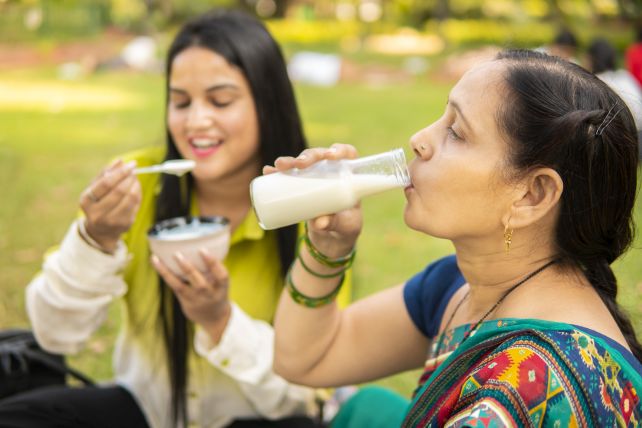
In fact, “The strength of selection acting on this allele may have been higher in the South Asian pastoralist populations than in Northern Europeans,” the researchers write in a preprint uploaded to bioRxiv.
“This is a great, careful, important study,” anthropologist Christina Warinner of Harvard University, who wasn’t involved in the research, told Science Magazine. “Our current explanation for how adult milk digestion works, and our understanding of lactose tolerance and intolerance, is really incomplete.”
Humans produce lactase as infants to break down the lactose in their mother’s milk. However, as children grow into adulthood, lactase production drops dramatically. If you can drink and digest lactose, you’re in a global minority: an estimated 70 percent of the global population has a lactase deficiency to some degree, with wide variation between ethnic and age groups.
In some groups of people, the -13910*T allele allows high levels of lactase production well into adulthood. It’s unclear how and why this trait spread globally, but scientists have often attributed it to natural selection in populations that consume a lot of dairy. Its low rate in South Asian populations, therefore, presents a bit of a puzzle.
Led by biologist Priya Moorjani of the University of California, Berkeley, a team of researchers assembled data from around 8,000 genomes, including present-day and ancient genetic material dating between 3300 BCE and 1650 CE.
They mapped the distribution of -13910*T across the South Asian subcontinent, finding a gradient from north to south.
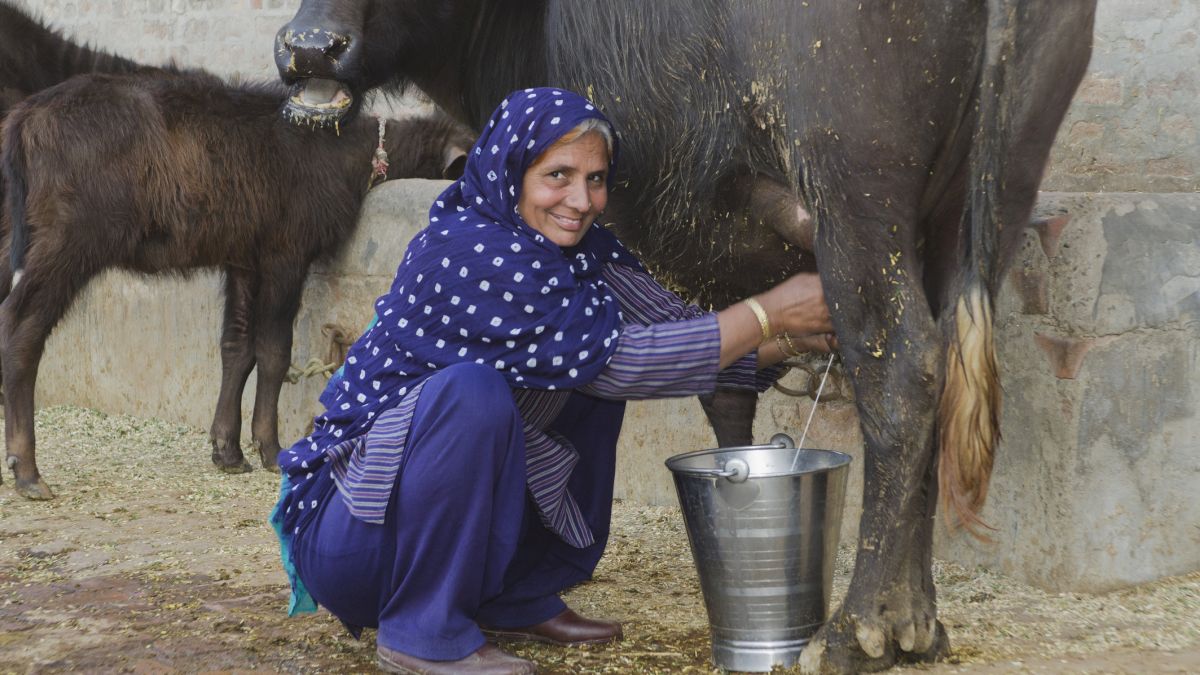
The milk-drinking gene is significantly more common in the north, becoming more scarce the further south you go, with one glaring exception – the Toda (South India) and Gujjar (Pakistan) groups, traditional buffalo herders, in which lactase persistence was as high as 90 percent of the population.
Then, they traced -13910*T back through time to see when and where it emerged. They also compared long stretches of DNA around the allele from South Asian populations against other populations to find the closest match.

Both sets of data indicated that the gene variant had been introduced by pastoralists on the Eurasian Steppe, whose -13910*T haplotype was almost identical to that of South Asian populations.
Finally, the researchers simulated different ways the variant could have potentially persisted at elevated rates, from natural selection to genetic drift.
The explanation that best fits the data is that the gene was imported from the Eurasian Steppe and amplified by positive selection pressures. And its unusual strength in the Toda and Gujjar populations may have had something to do with their lifestyle. As buffalo herders, their diet depends heavily on fresh dairy, including fresh milk, butter, buttermilk, yogurt, and cheese.
Given that both the Toda and Gujjar traditionally rely heavily on fresh milk, their unusually strong, recent selection for the milk-drinking gene is consistent with an influence from dairy-dependent lifestyles.
“Our findings reveal that the evolution of lactase persistence is not a single narrative of selection,” the researchers conclude, “but a mosaic of demographic and cultural histories, each leaving a distinct genetic imprint on the human genome.”
The research is available on bioRxiv.